
Reviewed · WORKSHOPS
Hanoi Knife-Making Class:Join the Legacy in Blacksmith’s Workshop
Steel, fire, and a story to take home. This Hanoi workshop brings you to Da Sy, a centuries-old blacksmithing village where you design, forge, shape, and sharpen your own knife. I like the hands-on work and the chance to learn from Tuyen, the only officially recognized female artisan in this trade. I also like the small-group setting, with a maximum of 10 people and guides such as Mint, Nick, and Tulip helping explain each step.
The main consideration is that this is active work, not a quiet craft class. You will hammer hot metal, use grinding equipment, and handle a sharp finished blade. You should also check your home country’s rules before carrying a knife through an airport.
In This Review
- Key points at a glance
- Why Da Sy makes this class different
- Meeting Tuyen, the female artisan behind the forge
- Choosing a blade and drawing your design
- Cutting the blade and tang with traditional tools
- Heating and hammering the metal
- Grinding, honing, and the tar-based sharpening step
- Shaping the wooden handle
- What the two-and-a-half-hour schedule means
- Is the $45.51 price good value?
- Practical details before you book
- Who will enjoy this Hanoi experience most?
- A useful souvenir with a real story
- Should you book the Da Sy knife-making class?
- FAQ
- Where does the knife-making class take place?
- How long does the experience last?
- How much does the class cost?
- What does the class include?
- Do I take home the knife I make?
- How many people can join the class?
- Is the activity suitable for most people?
- What is the cancellation policy?
Key points at a glance
- 44 years of blacksmithing skill: Tuyen has spent decades preserving Da Sy’s knife-making tradition.
- A real working village: Da Sy was once known for supplying weaponry during Vietnam’s historical wars.
- You make the knife yourself: The process covers design, cutting, forging, shaping, grinding, honing, and sharpening.
- A rare sharpening method: The workshop includes a tar-based wash described as a family technique passed down through generations.
- Small-group instruction: The class accepts no more than 10 people, with artisan guidance throughout.
- A useful souvenir: You leave with a functional knife made with your own hands, not a factory-made trinket.
Why Da Sy makes this class different
Many Hanoi craft activities are set up for visitors in a polished studio. This one takes you to Đa Sỹ, in Kiến Hưng, Hà Đông, where blacksmithing has been part of village life for centuries. That setting gives the class more weight. You are not simply copying a local design for an hour. You are working in a place known for making blades.
Da Sy also has a connection to Vietnam’s wartime past. The village was once known for supplying weapons, and its blacksmithing skills later continued through household tools and kitchen knives. The class presents that background while showing you the practical work behind the finished object.
I like that the focus stays on the craft. The experience does not appear to be built around a long list of sights or staged demonstrations. You spend your time choosing a design, working the metal, and learning how a local artisan controls heat, shape, and sharpness.
A few more Hanoi trips worth weighing up
- Hanoi Cooking Class: Culture, Local Market & Meaning CSR Impact
★ 5.0 · 5,147 reviews - 5 Traditional Dishes Hanoi Cooking Class with Market Trip
★ 5.0 · 4,890 reviews - Hanoi Coffee Workshop: Taste Salt, Coconut and Egg Coffee
★ 5.0 · 1,286 reviews
Meeting Tuyen, the female artisan behind the forge
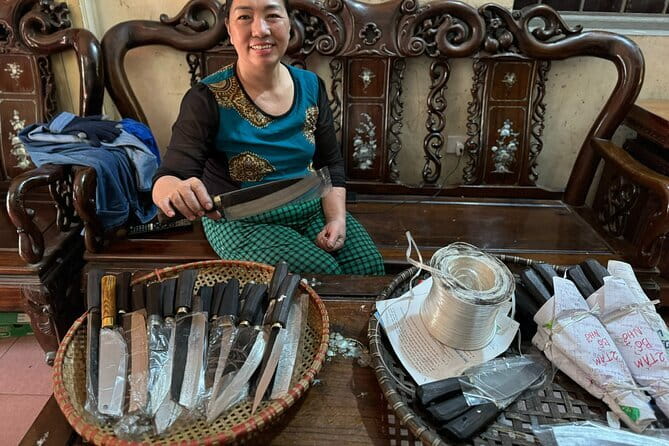
The central figure is Tuyen, a certified artisan who has dedicated 44 years to the trade. She is also described as the only officially recognized female artisan in this particular field, which gives the class a personal angle beyond its technical side.
You can expect her to guide the work closely, especially during the parts that require strength, timing, or careful control. The class is designed for beginners, and the available feedback points to patient instruction throughout the process. You will not be left to guess how to use the tools or where to place the metal.
An interpreter or guide helps bridge the language gap. Mint is described as personable and charming, while Nick and Tulip are also praised for friendly explanations and useful Hanoi advice. The guide matters here because blacksmithing has its own vocabulary and rhythm. Clear instructions are important when you are close to fire, hammers, cutters, and a grindstone.
Choosing a blade and drawing your design
The class begins with design. You sketch the shape of your knife on a selected piece of durable metal, with strength and quality taken into account. This is a small step, but it gives the finished object a personal mark.
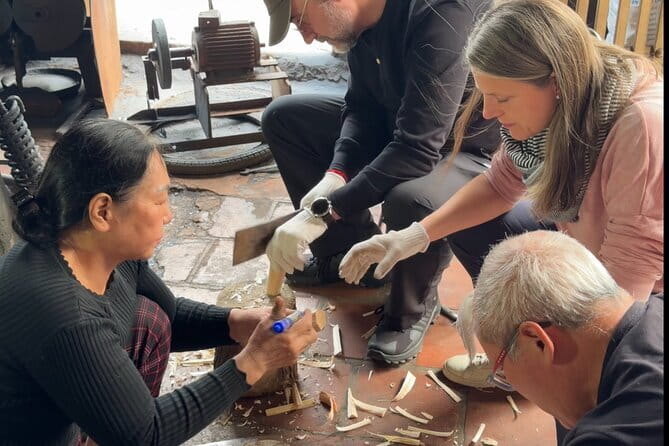
You may be able to customize the blade and handle, depending on the design you choose and the material available during the session. One detailed account describes beginning with a block of wood that still had bark on it, then shaping it into a handle. That is the kind of rough starting point that makes the final result feel personal.
Design is also where you need to be realistic. In roughly two and a half hours, you are not producing a museum-quality blade from raw ore. You are working through the main stages with expert help, using a prepared piece of metal and workshop machinery where needed. The result is handmade by you, but the artisan’s skill remains a vital part of the process.
Cutting the blade and tang with traditional tools
Once the design is chosen, you cut out the blade and tang. The tang is the section that extends into the handle, so its shape affects how the knife will later be assembled and held.
The workshop supplies the tools, including hammers, cutters, and an anvil. You will use traditional equipment under supervision rather than simply watching an artisan do the work. That distinction is the reason to book this class. You get a direct sense of how much force and control a blacksmith needs to create a clean form.
The class also supplies the necessary safety equipment. Still, you should treat this as serious workshop activity. Follow the artisan’s instructions closely, especially around the hot forge and cutting tools.
A completely different sort of day out of Hanoi:
- Hanoi Jeep Tour: Food, Culture and Fun by Vietnam Army Jeep
★ 5.0 · 15,222 reviews - Full-Day Ninh Binh Highlights Tour from Hanoi
★ 5.0 · 7,761 reviews - Hanoi: Ha Long Bay Day Cruise – Swimming, Meal, Kayaking
★ 4.7 · 7,415 reviews - Hanoi: Water Puppet Show Tickets
★ 4.6 · 7,029 reviews
Heating and hammering the metal
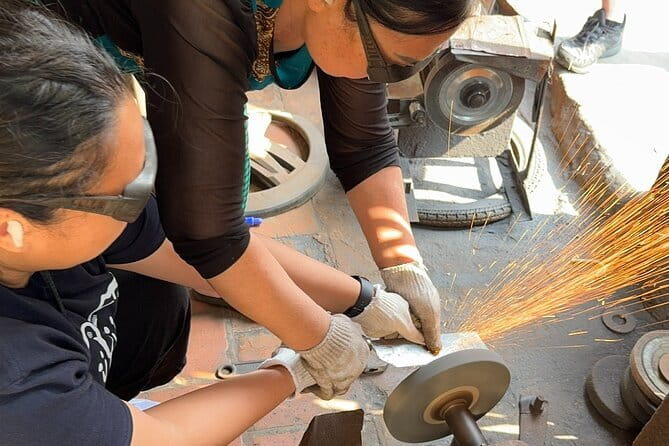
The metal is heated in the forge before shaping. You then take turns hammering it into the form you designed. This is likely the most physical part of the session, and it is where the class feels least like a standard souvenir activity.
Hammering hot steel is not simply a matter of hitting hard. The artisan shows you where to strike and how to work the material toward the right profile. Your role is hands-on, but the instructor’s corrections keep the piece moving in the right direction.
A hydraulic machine helps refine rough edges after the initial hammering. That is a practical compromise. Traditional hand tools give you the feel of the old process, while the machine helps produce a cleaner and more usable result within the short class period.
I see this balance as a strength. A fully manual knife-making course would take much longer and demand more experience. Here, you get the satisfaction of doing the meaningful stages yourself without being expected to match 44 years of professional skill.
Grinding, honing, and the tar-based sharpening step
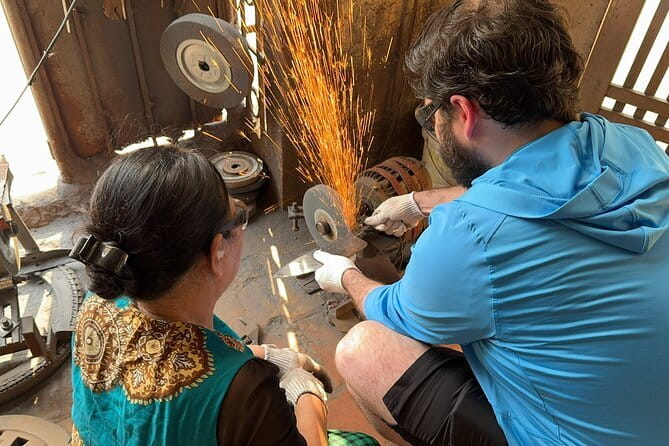
After forging and shaping, you work on the blade’s finish. Grinding removes rough areas and begins to define the cutting edge. Further honing and sharpening bring the knife closer to its usable form.
The sharpening stage includes a grindstone and a tar-based wash. This unusual technique is described as an old family secret passed down through generations. It is one of the most distinctive details in the class because it connects a practical step to family knowledge that is not easy to see in a normal Hanoi sightseeing program.
Do not expect to leave with a factory-perfect edge produced instantly by a machine. The point is to learn the sequence and feel the work involved. You may need patience as you refine the blade, and the artisan remains important in making sure the final knife is properly shaped and safe to handle.
Shaping the wooden handle
The handle gives the knife much of its individual character. You can customize it along with the blade, and the available details suggest that the work can begin with a rough wooden block, even one retaining bark.
That rough-to-finished process is satisfying because the handle changes visibly under your hands. You are not only making a metal blade. You are creating something designed to be held and used.
The exact handle choices are not specified, so you should not book expecting a particular wood, color, or decorative pattern. Ask the provider about current material options if handle design is especially important to you.
What the two-and-a-half-hour schedule means
The listed duration is about 2 hours and 30 minutes. That is long enough to cover the full sequence, from design through sharpening, but short enough to fit into a busy Hanoi itinerary.
The schedule works best if you arrive ready to focus. You will be moving between several stages rather than spending a long time at one bench. The experience is active and practical, so it may feel quick once the forging begins.
I would place it on a day when you are not rushing to catch a flight immediately afterward. The class ends back at the meeting point in Đa Sỹ, and the work itself deserves your attention. If you book it on your final day, leave room for transport and for checking how you will legally take the finished knife home.
Is the $45.51 price good value?
At $45.51 per person, the class costs more than buying an ordinary kitchen knife in Hanoi. That is not the right comparison. You are paying for artisan instruction, access to a working forge, safety equipment, materials, interpretation, and the chance to make the object yourself.
The value is strongest if you care about process. You learn how a blade is cut, heated, hammered, ground, and sharpened, then take home the result. The knife also carries a clear connection to Da Sy and to the artisan who guided you.
The value is weaker if you only want a cheap souvenir or a relaxed activity with little physical effort. This is not a bargain-shopping stop, and it is not a craft session where you can sit back while someone else does the difficult work.
With a maximum of 10 people, the price also supports a more personal format than a large demonstration. The class can still vary depending on group size, but the stated limit gives the artisan a reasonable chance to watch each person’s technique.
Practical details before you book
The meeting point is Đa Sỹ, Kiến Hưng, Hà Đông, Hanoi, Vietnam. The activity ends at the same point. It is near public transportation, though the supplied details do not specify the best route, travel time, or whether transport is included.
A mobile ticket is provided, and confirmation arrives at booking. All tools and required safety equipment are supplied at the artisan’s house. Gratuities are optional and not included.
Most people can participate, and service animals are allowed. The experience does involve heat, metalwork, hammering, grinding, and sharp tools, so you should consider your own comfort with physical workshop tasks before booking.
Knife transport deserves special attention. One participant noted checking airport and home-country rules for a small finished knife. Rules differ by country and by airline, and a knife that is acceptable in one place may be restricted in another. Check before you commit, particularly if you are flying soon after the class.
Who will enjoy this Hanoi experience most?
I would recommend this to you if you like making things, enjoy local craft traditions, or want a souvenir with a story behind it. It also suits repeat visitors who have already seen Hanoi’s main sights and want a more specific connection with the city’s working culture.
Families with older children or teenagers may find it appealing, provided everyone can follow safety instructions. Couples and friends can also make it a shared project, especially if you design knives with different handles or blade shapes.
This may not suit you if you want a quiet, low-effort afternoon. The work includes hammering, grinding, and close attention to instructions. Anyone uncomfortable around fire or sharp tools should choose a different class.
The format is also best for people who value guidance. You are not being handed a kit and sent to a table. The artisan’s corrections and demonstrations are central to the experience.
A useful souvenir with a real story
The finished knife is the strongest reason to choose this class over another Hanoi activity. You leave with something functional, shaped by your choices and marked by the work you put into it.
It is also a good reminder of the difference between buying local and making local. A shop-bought knife may be attractive, but this one connects you to the village, the forge, the tools, and Tuyen’s long career.
You should still handle the knife responsibly once it is finished. Pack it according to airline and airport rules, and check your destination’s regulations before departure. The class gives you a handmade object, but it does not remove the practical rules that apply to transporting blades.
Should you book the Da Sy knife-making class?
Book it if you want a genuine, hands-on craft experience and you are comfortable with heat, hammering, and sharp tools. The combination of Da Sy’s blacksmithing tradition, Tuyen’s 44 years of experience, patient interpretation, and a knife you make yourself gives the $45.51 fee solid value.
Skip it if you want a passive activity, a simple souvenir, or a class with no safety concerns. For the right person, though, this is one of Hanoi’s more memorable ways to spend two and a half hours. Check transport and airport rules first, then arrive ready to work.
FAQ
Where does the knife-making class take place?
The class takes place at Đa Sỹ, Kiến Hưng, Hà Đông, Hanoi, Vietnam, at the artisan’s house.
How long does the experience last?
The workshop lasts approximately 2 hours and 30 minutes.
How much does the class cost?
The listed price is $45.51 per person.
What does the class include?
Tools and all necessary safety equipment for knife making are provided at the artisan’s house.
Do I take home the knife I make?
Yes. The experience includes making a handmade knife that you can take home, subject to the transport and customs rules that apply in your country and with your airline.
How many people can join the class?
The activity has a maximum group size of 10 people.
Is the activity suitable for most people?
Most people can participate, and service animals are allowed. The class includes working with fire, metal, hammers, grinding equipment, and a sharp blade, so you should be comfortable following workshop safety instructions.
What is the cancellation policy?
You can cancel at least 24 hours before the start time for a full refund. Cancellations or changes made less than 24 hours before the experience are not refunded or accepted.
Just added around Hanoi
- Hanoi: Make 6 Iconic Coffees in a Heritage Home with Locals★ 5.0 · 32 reviews
- Private Ninh Binh Full Day (Bich Dong -Tam coc -Mua cave- Biking)★ 5.0 · 32 reviews
- Retro Hop-on-hop-off Bonbon City Tour: Classic Package★ 4.0 · 32 reviews
- 15-Day Vietnam Itinerary All in One | Travel Package 2026-2027★ 5.0 · 32 reviews
- Verdure Lotus Classic Cruise in Halong Bay & Lan Ha Bay (2D1N)★ 4.0 · 32 reviews
- 10-Day Vietnam Discovery from North to South | Best Packages★ 5.0 · 32 reviews
- Full-day Guided Meditation Experience in Ha Noi★ 5.0 · 33 reviews
- Private Transfers Hanoi <=> Halong One Way by Limousine Vehicles★ 5.0 · 33 reviews
Workshops, compared.

Hanoi Cooking Class: Culture, Local Market & Meaning CSR Impact
Read our review →
5 Traditional Dishes Hanoi Cooking Class with Market Trip
Read our review →
Vietnamese Coffee Culture and Coffee Making Class
Read our review →
Cooking Class Hoi An:Local Market, Basket Boat, Fishing & Cooking
Read our review →
Hoi An Cooking Class(Market,BasketBoat Crabfishing&Cooking Class)
Read our review →
Market Tour, Basket Boat Ride and Cooking Class
Read our review →
Hoi An Full Lantern Making Class- A special Foldable lantern
Read our review →Browse the lists this tour appears in