
Reviewed · WORKSHOPS
Hanoi Knife Making Traditional Workshop
Hot metal, family skills, and a useful souvenir. This Hanoi knife-making class takes you beyond the city center to a traditional craft village where forging has been practiced for several hundred years. You sketch a blade, cut and heat the metal, hammer it into shape, and sharpen the finished knife with help from local makers.
I like the hands-on format, since you do more than watch a demonstration. I also like the chance to meet a forging family and learn how their work connects to Vietnam’s wartime past and present-day farming life. The main consideration is that this is a physical activity around heat, hammers, and machinery, so it may not suit anyone looking for a gentle sightseeing outing.
I especially value the small group size, with no more than 10 people, and the patient instruction praised by past participants. Guide Nathan is singled out as engaging and helpful, while the family makers are described as welcoming and willing to let you choose the knife’s size. At about three and a half hours, the class takes a useful half-day from Hanoi, and lunch is not included.
In This Review
- Key points before you book
- Why this Hanoi workshop feels different
- Leaving Hanoi for a traditional craft village
- Meeting the family behind the forge
- Sketching a blade before the fire
- Cutting and forging the hot metal
- Shaping the blade with a local maker
- Sharpening, grinding, and the family recipe
- What the $50 price includes
- Who will enjoy this unusual souvenir
- Booking, weather, and cancellation details
- Should you book the Hanoi knife-making class?
- FAQ
- How long does the Hanoi knife-making workshop last?
- What is included in the price?
- Is lunch included?
- How many people can join the workshop?
- Do I need a certain level of fitness?
- Can I cancel for a full refund?
- What happens if bad weather cancels the class?
Key points before you book
- Make a knife from raw metal: You take part in design, cutting, forging, shaping, and sharpening rather than simply watching a finished blade being made.
- Visit a historic forging village: The village has practiced metalwork for several hundred years and once produced weapons during Vietnam’s wars.
- Work beside family bladesmiths: The craft is taught within a local family whose members have trained in the trade from a young age.
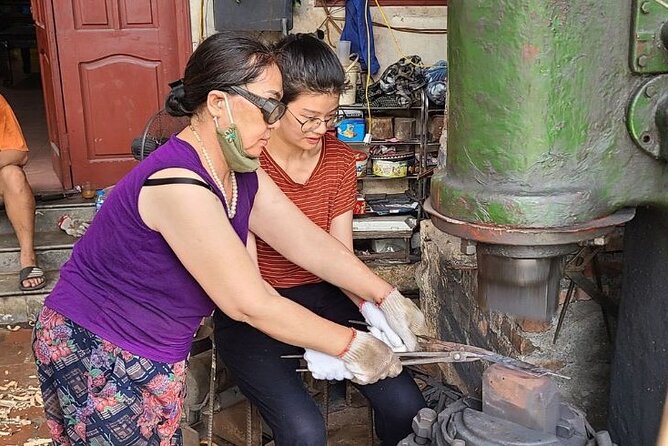
- Expect real workshop conditions: You will handle a hammer and work near hot embers, a grindstone, and a hydraulic cutting machine.
- Small groups improve the lesson: The maximum group size is 10 people, giving you more room for guidance.
- Bring time, not lunch: The activity lasts about 3 hours and 30 minutes, includes transport and an English-speaking guide, but does not include a meal.
Why this Hanoi workshop feels different
Hanoi has no shortage of cooking classes, market walks, and city tours. This one offers something less polished and more unusual: you make a practical object with the help of people who have spent years working metal.
The village’s forging tradition goes back several hundred years. During Vietnam’s wars, it was known as a source of weapons. Today, the work is tied more closely to agricultural tools and everyday implements. That change gives the visit useful context. You are not seeing a frozen folk display. You are seeing an old trade adapt to modern needs.
I like this kind of cultural stop because the craft explains the place. The workshop is not just a backdrop for a souvenir. The tools, the heat, the family teaching system, and the continued production of farm equipment all show how a local skill survives.
You should also set your expectations correctly. This is not a polished museum demonstration where you stand at a safe distance and take photographs. You will be involved in the process, with guidance. The work is simple enough to be taught in a half-day, but it still requires attention and some physical effort.
A few more Hanoi trips worth weighing up
- Hanoi Cooking Class: Culture, Local Market & Meaning CSR Impact
★ 5.0 · 5,147 reviews - 5 Traditional Dishes Hanoi Cooking Class with Market Trip
★ 5.0 · 4,890 reviews - Hanoi Coffee Workshop: Taste Salt, Coconut and Egg Coffee
★ 5.0 · 1,286 reviews
Leaving Hanoi for a traditional craft village
The experience begins in Hanoi, with an air-conditioned vehicle included. Pickup is offered, which matters in a city where getting across town can take longer than the map suggests. Exact pickup timing and location are not provided, so you should check those details when booking.
The ride takes you out toward a village known for its forging profession. The change from city streets to a working craft community is part of the appeal, even though the supplied details do not give a precise travel time or name the village.
An English-speaking guide accompanies the outing. Nathan receives particular praise for being patient, engaging, and good company during the journey. That is useful here because the class includes several technical steps, and clear explanations matter when you are working with hot metal and unfamiliar tools.
The group limit is 10 people. That is not a private lesson, but it is small enough to make personal instruction more realistic than it would be in a large coach group. If several people are learning at once, expect some waiting while the maker demonstrates or helps another person.
Meeting the family behind the forge
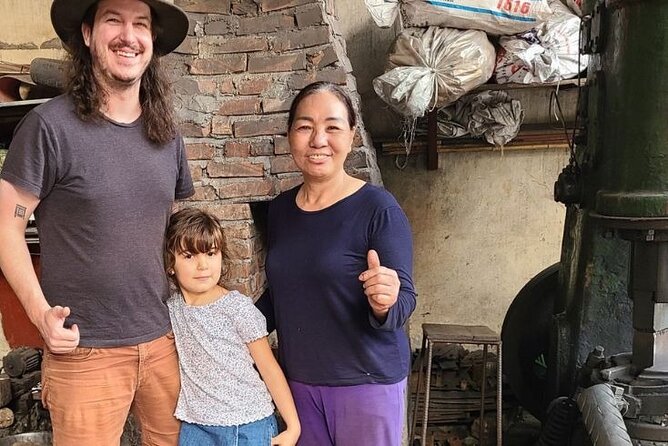
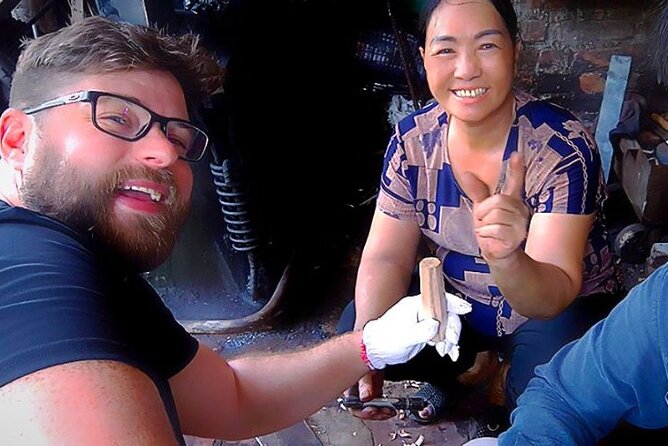
At the workshop, you meet local makers from a family that has worked in knife and tool production for generations. One family member explains that people in the trade may begin as young as 12. That detail gives you a sense of how much practice sits behind the quick, confident movements you will see.
The family’s experience is important because you are not being handed a generic tourist craft kit. You are learning beside people who know how metal behaves under heat, pressure, and repeated hammer blows.
The strongest part of the experience is likely to be the exchange with the makers. You can chat with locals, ask about their work, and see how a family trade is passed from one generation to the next. The details provided do not promise a formal lecture, so expect conversation and demonstration rather than a long historical presentation.
This is also where the visit may feel most personal. You are not just buying a knife from a shop shelf. You are watching the steps that turn a piece of iron material into a useful blade, with the family’s methods shaping the result.
Sketching a blade before the fire
Your knife begins with a design. You sketch the shape of the blade on a sheet of metal chosen for durability. This first stage sounds simple, but it gives you a say in the final object.
Past participants have been able to choose the knife’s size. That is a helpful feature, especially if you want a compact cooking knife rather than a larger tool. The available information does not specify the exact range of sizes or blade designs, so you should treat the choice as guided rather than unlimited.
The design stage also makes the activity accessible to beginners. You do not need to arrive knowing how to draw a blade or understand metalwork. The maker guides you through a practical shape that can be cut, forged, and sharpened within the available time.
I like that the process begins with a decision rather than a preselected souvenir. Your final knife may still reflect the maker’s expertise more than your own, but the sketch gives you a clear role from the start.
A completely different sort of day out of Hanoi:
- Hanoi Jeep Tour: Food, Culture and Fun by Vietnam Army Jeep
★ 5.0 · 15,222 reviews - Full-Day Ninh Binh Highlights Tour from Hanoi
★ 5.0 · 7,761 reviews - Hanoi: Ha Long Bay Day Cruise – Swimming, Meal, Kayaking
★ 4.7 · 7,415 reviews - Hanoi: Water Puppet Show Tickets
★ 4.6 · 7,029 reviews
Cutting and forging the hot metal
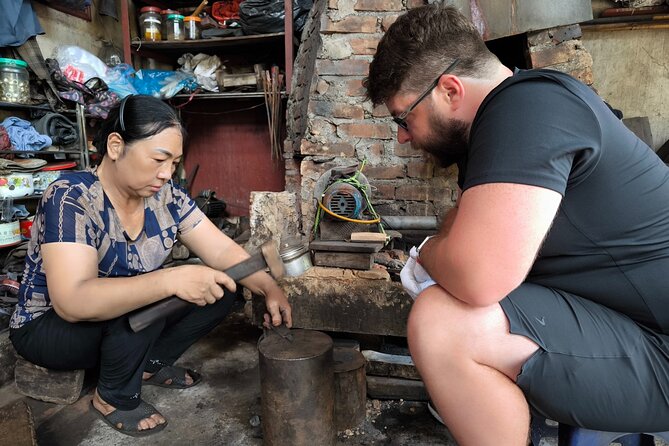
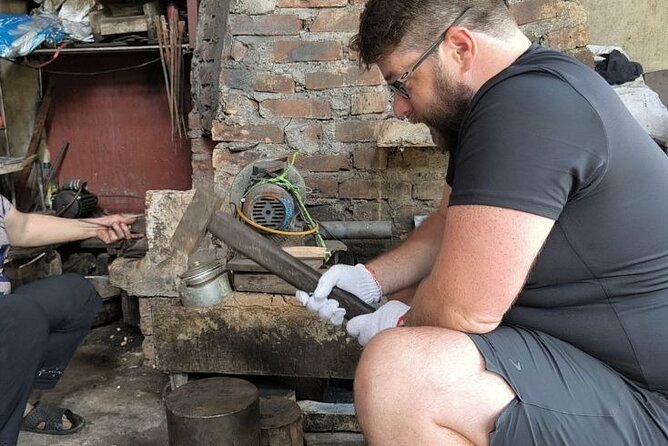
After the design comes the loudest and most physical part. Using a hammer, cutter, and anvil, you cut out the blade and tang. The tang is the section that extends into the handle, so this step creates both the cutting edge and the part that will connect to the grip.
The metal then goes into crackling embers. You alternate hammer blows with the maker to shape it. This is where the class becomes genuinely hands-on. You will not be expected to perform the entire process alone, and the experienced maker remains close to correct your technique and keep the work moving.
Expect heat, noise, and repetition. A hammer and anvil are not light tools, and shaping metal takes effort. The stated requirement for moderate physical fitness is worth taking seriously. You may need to stand, grip tools, and swing the hammer repeatedly.
The physical work is also the reason this class has more value than a simple demonstration. You feel how difficult it is to control a piece of heated metal. Even if the maker does much of the precision work, your few well-placed blows help you understand the craft.
If you have limited strength or dislike hot work, this could be the point where the activity becomes less enjoyable. The experience is not described as adapted for different physical needs, so ask the provider before booking if you have concerns.
Shaping the blade with a local maker
Forging gives the metal its rough form, but the blade still needs correction. You work alongside the maker, alternating blows to bring the shape closer to the design. This shared rhythm is one of the most appealing parts of the class.
The local maker knows how much force to use and where the metal needs attention. You are learning by doing, but you are also relying on someone with years of skill. That balance keeps the activity safe and practical while allowing you to take part.
Any rough edges or imperfections are trimmed with a hydraulic cutting machine. This is an important detail because it shows the finished knife is not expected to be perfect after your hammer work. The machine helps refine the shape and removes mistakes that would be difficult to correct by hand in a short class.
You should think of the workshop as a cooperative making session. You contribute to the design and the basic shaping, while the craftspeople handle the precision required for a usable final product. That is not a weakness. It is the honest way to make a functioning knife during a short visit.
Sharpening, grinding, and the family recipe
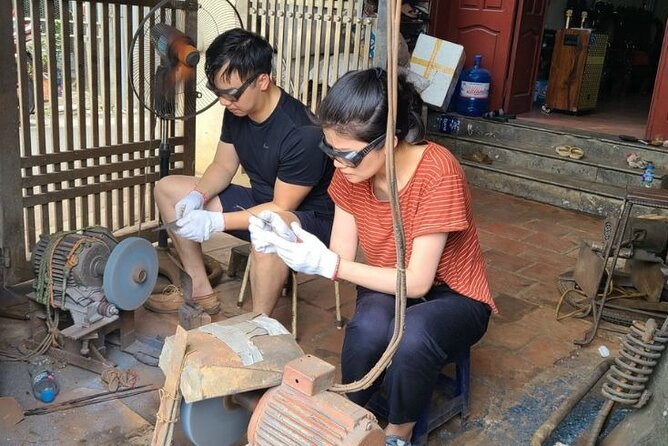
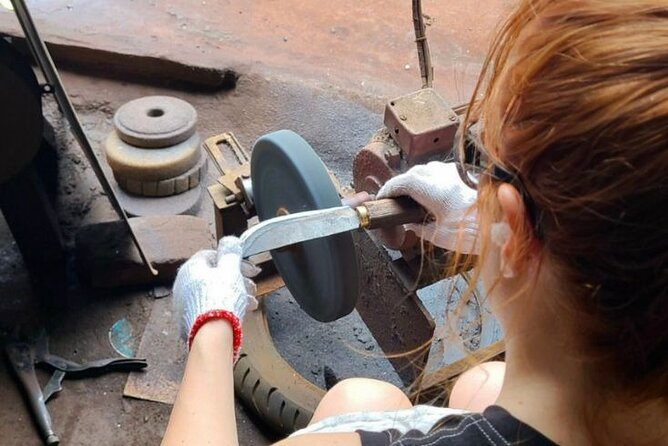
The final stages focus on sharpening the blade on a grindstone. This is another multi-step process, and the supplied details note that one phase involves soaking the blade in a tar-based chemical wash made from a secret family recipe.
That detail adds a strong sense of place. The knife is not simply cut, hammered, and handed over. It goes through a finishing process that belongs to the family’s method.
You should expect the maker to control some of the more exact sharpening work. A sharp blade requires care, and the class is designed to let you learn the process without pretending that a first-time visitor can match a trained bladesmith.
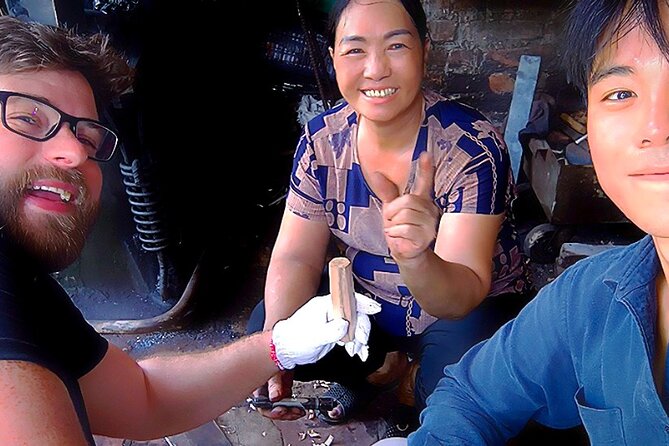
The finished knife becomes your souvenir. It is more personal than a factory-made item because you helped shape it and watched the family complete the difficult stages. The experience description presents it as a cooking knife, though the exact final design and handle details are not specified.
If you are flying onward, check the rules for carrying a knife with your airline and destination before booking. The tour information does not explain how the knife is packaged or transported after the class, so this is one practical detail worth confirming directly with Hanoi Day Trips.
What the $50 price includes
The cost is $50 per person. That includes the air-conditioned vehicle, iron material, and an English-speaking guide. It also covers the instruction and the workshop activity, though the supplied details do not break out each individual fee.
For a three-and-a-half-hour outing, the price can make sense if you want a real activity rather than a short photo stop. You receive transport, local interpretation, materials, and a finished knife. The small maximum group of 10 adds to the value because the maker has a better chance of spending time with you.
The price is less attractive if you mainly want to see a village and take pictures. In that case, you are paying for the making process, not just access to a craft community. The value depends on your willingness to swing a hammer, listen to instruction, and take part.
Lunch is not included. Since the activity lasts about half a day, plan your meal before or after the class. Tips are also not included, so you can budget separately if you feel the guide and makers gave you good help.
Group discounts are offered, but the available information does not state the discount amount or the number of people required. Ask for the exact terms if you are booking with friends or family.
Who will enjoy this unusual souvenir
I would recommend this class most strongly to people who like making things, local trades, and activities with a story. It suits couples, families with older children, and curious adults who have already seen Hanoi’s main sights and want a different half-day.
It is also a good fit if you want a souvenir with a personal connection. You do not just purchase a knife. You choose a size, help form the blade, and watch a family of makers finish it using methods passed through generations.
The class may not suit you if you dislike heat, noise, or physical work. It is not a passive cultural tour. Moderate fitness is required, and the use of hammers, embers, a cutting machine, and a grindstone gives the workshop a practical, industrial feel.
People expecting a fully independent blacksmithing session should also adjust their expectations. The makers will guide and assist you, and they will likely complete the precision work. The result is a cooperative craft lesson, not a test of whether you can become a bladesmith in one afternoon.
Booking, weather, and cancellation details
Confirmation is provided at the time of booking. Pickup is offered, mobile tickets are available, and the group is capped at 10 people.
Free cancellation is available up to 24 hours before the local start time for a full refund. Cancellations or changes made within 24 hours are not refunded or accepted.
The activity requires good weather. If poor weather causes a cancellation, you can receive a different date or a full refund. The experience also requires a minimum number of participants. If that minimum is not reached, you will be offered another date or experience, or receive a full refund.
Should you book the Hanoi knife-making class?
Book it if you want a hands-on cultural experience and you are happy to trade a standard sightseeing stop for heat, hammering, and a useful handmade souvenir. The family setting, small group limit, English guide, and chance to choose the knife’s size make this more personal than a simple craft demonstration.
I would skip it if you want a relaxed outing, need a fully accessible activity, or have no practical plan for carrying a knife afterward. For the right person, $50 is fair value for transport, instruction, materials, and several hours beside working makers.
The best reason to book is simple: this class gives you a story to take home, not just an object. You will remember the red-hot metal, the sound of the anvil, and the family skill behind the blade long after another souvenir has been forgotten.
FAQ
How long does the Hanoi knife-making workshop last?
The activity lasts approximately 3 hours and 30 minutes.
What is included in the price?
The price includes an air-conditioned vehicle, iron material, and an English-speaking tour guide.
Is lunch included?
No. Lunch is not included in the experience.
How many people can join the workshop?
The maximum group size is 10 people.
Do I need a certain level of fitness?
Yes. Participants should have a moderate level of physical fitness because the activity includes hammering and other workshop tasks.
Can I cancel for a full refund?
Yes. You can cancel at least 24 hours before the experience start time for a full refund. Cancellations within 24 hours are not refunded.
What happens if bad weather cancels the class?
You will be offered a different date or a full refund if poor weather causes the experience to be canceled.
Just added around Hanoi
- Hanoi: Make 6 Iconic Coffees in a Heritage Home with Locals★ 5.0 · 32 reviews
- Private Ninh Binh Full Day (Bich Dong -Tam coc -Mua cave- Biking)★ 5.0 · 32 reviews
- Retro Hop-on-hop-off Bonbon City Tour: Classic Package★ 4.0 · 32 reviews
- 15-Day Vietnam Itinerary All in One | Travel Package 2026-2027★ 5.0 · 32 reviews
- Verdure Lotus Classic Cruise in Halong Bay & Lan Ha Bay (2D1N)★ 4.0 · 32 reviews
- 10-Day Vietnam Discovery from North to South | Best Packages★ 5.0 · 32 reviews
- Full-day Guided Meditation Experience in Ha Noi★ 5.0 · 33 reviews
- Private Transfers Hanoi <=> Halong One Way by Limousine Vehicles★ 5.0 · 33 reviews
Workshops, compared.

Hanoi Cooking Class: Culture, Local Market & Meaning CSR Impact
Read our review →
5 Traditional Dishes Hanoi Cooking Class with Market Trip
Read our review →
Vietnamese Coffee Culture and Coffee Making Class
Read our review →

Cooking Class Hoi An:Local Market, Basket Boat, Fishing & Cooking
Read our review →
Hoi An Cooking Class(Market,BasketBoat Crabfishing&Cooking Class)
Read our review →
Market Tour, Basket Boat Ride and Cooking Class
Read our review →
Hoi An Full Lantern Making Class- A special Foldable lantern
Read our review →Browse the lists this tour appears in