
Reviewed · WORKSHOPS
Hanoi Knife Making Traditional Workshop
Make a knife, meet a family of smiths. In Da Sy village, on Hanoi’s outskirts, you learn how a plain sheet of steel becomes a working blade through fire, hammering, grinding, and careful finishing. I like the hands-on format, and I like that your finished knife becomes a useful souvenir rather than another shop-bought trinket. The main consideration is that this is a beginner class, so experienced metalworkers may find that the master handles some of the harder work.
The three-hour outing also gives you a look at a traditional craft village and time with local makers. Guides such as Tee, Nathan, Khoi, and Minh have been praised for clear English, translation, transport, and friendly conversation. Heat, sharp tools, and heavy machinery are part of the setting, so you need comfortable shoes and a willingness to follow safety instructions closely.
In This Review
- Key points to know before booking
- Why Da Sy village matters to the experience
- Hotel pickup makes the half-day simple
- Choosing a knife before the fire starts
- Cutting and hammering the steel
- Shaping the blade and learning the limits
- Grinding, tempering, and the final edge
- Carving and fitting the handle
- Hospitality after the work
- Is $50 a fair price?
- Who will enjoy this Hanoi craft experience?
- Should you book the Da Sy knife workshop?
- FAQ
- Where does the knife-making workshop take place?
- How long does the experience last?
- Is hotel pickup included?
- Is the workshop conducted in English?
- What is included in the $50 price?
- Can I choose the knife design?
- Will I make the entire knife myself?
- What should I wear or bring?
- Are there any restrictions on participation?
- Can I cancel the booking?
Key points to know before booking
- Forge a working knife in Da Sy village: You take part in the process from blade design through sharpening and handle work.
- Learn beside a family-run workshop: Local craft workers demonstrate techniques and guide your hands through each stage.
- Hotel pickup is included: Transport takes you from your Hanoi hotel to the village and back.
- Choose your blade design: You can select from offered shapes, and some sessions allow you to work from a personal photo or adapt a design.
- Keep the finished product: Your knife is included, giving you a practical reminder of your time in Vietnam.
- Expect a small-group feel: Some sessions are private or shared with only one other participant, though group size can vary.
Why Da Sy village matters to the experience
This is not a knife class in a polished city studio. The workshop takes place in Da Sy, a Hanoi craft village known for forging. The trade reaches back several hundred years, and the village once supplied weapons during Vietnam’s wars. Today, the work is more closely tied to agricultural tools and everyday blades, but the basic relationship between steel, heat, and hand skill remains.
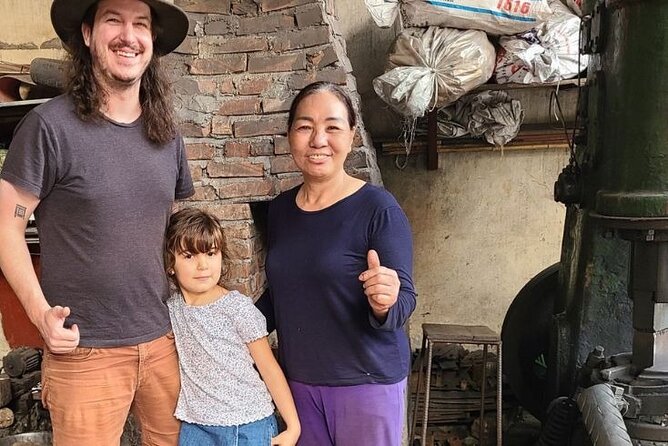
That setting gives the activity its value. You are not simply shown a finished knife and told a few facts. You see a working family business and meet the people who keep the craft going. The English-speaking guide helps explain the village and translates between you and the craft workers, many of whom do not speak English.
Guides have added plenty of warmth to the outing. Tee is frequently praised for explaining the process and helping with translation. Nathan has been described as friendly and easy to talk with during the drive, while Khoi has been praised for looking after the group from hotel pickup to the return journey. Minh has also received strong praise for punctual transport and clear demonstrations.
The guide may also share small local touches along the way, such as Vietnamese fruit, tea, or candy. One guide even took a hungry participant to a favorite food place before the workshop. These details are not the main event, but they can make the trip feel more personal.
A few more Hanoi trips worth weighing up
- Hanoi Cooking Class: Culture, Local Market & Meaning CSR Impact
★ 5.0 · 5,147 reviews - 5 Traditional Dishes Hanoi Cooking Class with Market Trip
★ 5.0 · 4,890 reviews - Hanoi Coffee Workshop: Taste Salt, Coconut and Egg Coffee
★ 5.0 · 1,286 reviews
Hotel pickup makes the half-day simple
The experience lasts about three hours, with starting times shown when you check availability. Hotel pickup is included, and you are asked to wait five minutes in your hotel lobby. A driver takes you toward the village, with the guide joining the journey and helping you understand what you are seeing.
This matters because Da Sy is outside central Hanoi. You do not have to work out local transport, find the workshop yourself, or worry about getting back after handling hot steel. The included ride adds real value to the $50 price.
The exact pickup time depends on the date you select. Since the activity is listed as a small-group experience, you might share the vehicle and workshop with a few people, or you might find yourself in a private or nearly private session. Several sessions have involved only one or two participants, while one group of six made knives together.
The drive is also part of the lesson. Your guide can explain local history and daily life before you arrive, giving the village visit more meaning than a quick transfer would. Still, allow room in your morning or afternoon for traffic, since Hanoi journeys can take longer than the clock suggests.
Choosing a knife before the fire starts
At the workshop, you begin by deciding what kind of knife you want to make. You may choose from a range of suggested shapes, and some sessions allow you to use a photograph as a guide or combine features from different designs.
That choice is important. You are not handed a standard object and asked to decorate it. You have a say in the blade profile and, in some cases, the handle shape. One participant created a hybrid design based on a traditional workshop style and a Japanese kiritsuke. Others chose kitchen knives.
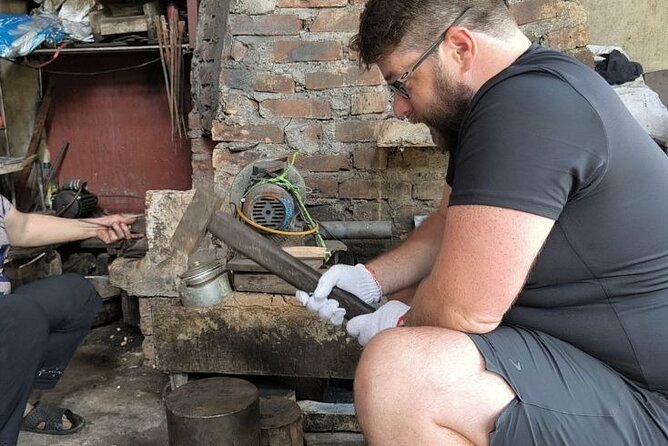
You then sketch the blade outline on a sheet of durable metal. This gives you a first look at how much thought goes into a tool that seems simple when finished. The blade must have a useful shape, while the tang, the section that extends into the handle, must be long and strong enough to support it.
This part is accessible to beginners. You do not need blacksmithing experience or technical drawing skills. The master and guide help turn your idea into a shape that can actually be forged.
Cutting and hammering the steel
The next stage brings you close to the central work of the forge. Using tools such as a hammer, cutter, and anvil, the workshop cuts out the blade and tang. The steel then goes into the glowing embers.
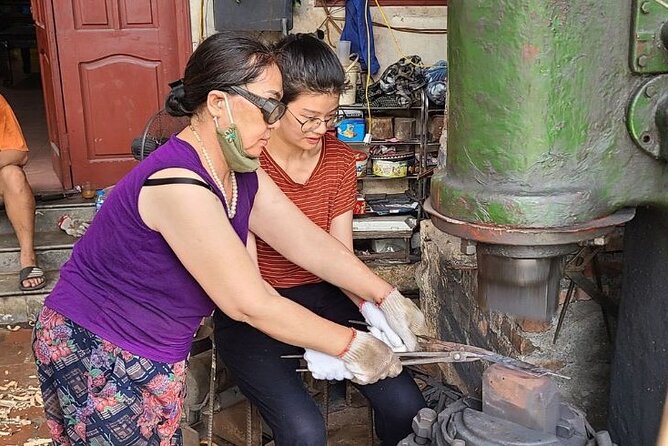
You take part in the hammering under close supervision. The aim is not to swing wildly or prove how strong you are. It is to learn how repeated, controlled blows change hot metal. You alternate with the maker as the blade begins to take form.
This is one of the most enjoyable sections because you feel the craft in your hands. You also quickly see why skilled forging takes years to master. The maker reads the metal, heat, angle, and thickness in a way a first-time participant cannot.
Here is where expectations need a little adjustment. The class is designed for true beginners, and safety comes first. You may hammer the steel several times and handle many steps, but the master will take over when a task is too risky or requires exact control. Some participants have been heavily involved in the process, while others have preferred to let the professional handle more of the work.
That balance is sensible. A hydraulic cutting machine is used to trim imperfections, and the dangerous machinery is not treated like a toy. You may be offered a choice between doing as much as possible yourself or allowing the master to complete more of the technical work. If you want maximum hands-on time, say so clearly at the beginning.
A completely different sort of day out of Hanoi:
- Hanoi Jeep Tour: Food, Culture and Fun by Vietnam Army Jeep
★ 5.0 · 15,222 reviews - Full-Day Ninh Binh Highlights Tour from Hanoi
★ 5.0 · 7,761 reviews - Hanoi: Ha Long Bay Day Cruise – Swimming, Meal, Kayaking
★ 4.7 · 7,415 reviews - Hanoi: Water Puppet Show Tickets
★ 4.6 · 7,029 reviews
Shaping the blade and learning the limits
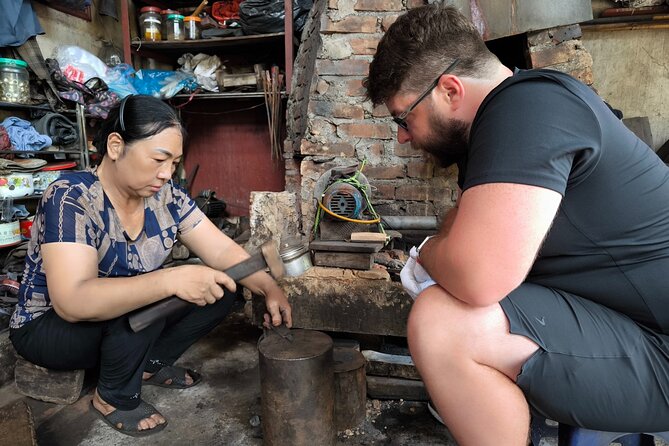
Once the main outline is forged, the blade needs careful shaping. The workshop trims rough edges and corrects faults before moving to grinding and finishing.
You will see a mix of old and modern methods here. The anvil and hammer represent the older craft, while the hydraulic cutter handles jobs that would be unsafe or inefficient by hand. This combination is useful to watch because it shows that traditional work does not mean refusing every modern tool.
The family makers are patient, which helps if your first hammer blows are awkward. They demonstrate each movement and may guide your grip or adjust your hands. The English-speaking guide translates the instructions, but the makers also communicate through clear physical demonstrations.
You should treat the workshop as a real forge, not a staged craft demonstration. Wear comfortable shoes. Use the gloves provided or recommended by the workshop, and follow every warning around the fire, grinder, cutter, and finished blade. Alcohol and drugs are not allowed.
The activity is not suitable for people over 95, according to the booking information. More broadly, anyone who has difficulty standing, handling tools, or working around heat should consider the physical demands before reserving.
Grinding, tempering, and the final edge
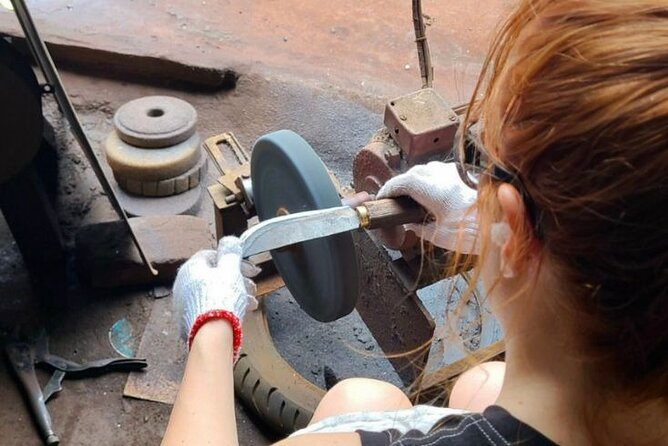
After forging and trimming, the blade moves to the grindstone. This is where the rough metal becomes a recognizable knife. Sharpening involves several stages, and the master controls the final edge so that you leave with a usable product.
One step involves soaking the blade in a special tar-based chemical wash made from a secret family recipe. You may not learn the exact formula, but you do see that finishing a blade involves more than simply rubbing it against a stone. Heat treatment, surface treatment, grinding, and sharpening all affect the final result.
The experience can include tempering the metal and polishing the blade. The exact amount of work you do depends on the group, your confidence, and the safety of each tool. Some people have taken part in nearly every stage, from hammering and polishing to sharpening. Others have watched the master complete the most precise work.
That difference is worth keeping in mind when you read the phrase make your own knife. You will contribute meaningfully, but you are not being trained as a professional bladesmith in three hours. The master’s skill is what ensures the finished knife is straight, sharp, and safe to use.
Carving and fitting the handle
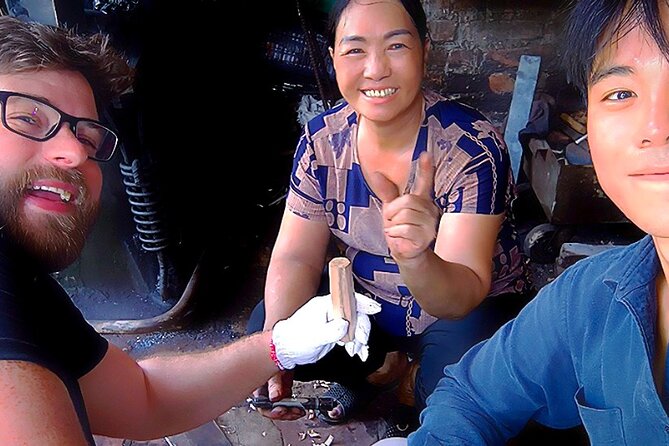
The handle gives you another chance to shape the final object. Participants have carved wooden handles and, in some cases, adjusted the design so the knife fits their hands.
This is a nice part of the workshop because it makes the souvenir more personal. A factory knife has no connection to your decisions. Here, the blade shape, handle form, and amount of finishing work can reflect your choices.
The master still has the final say on safe construction. The tang must fit correctly, and the handle must be secure. Your guide translates the instructions and helps keep the pace moving, while the craft worker checks the technical details.
The finished knife is included in the $50 cost. That makes the experience feel stronger than a short demonstration with nothing to take home. Some participants have also bought extra knives from the workshop at reasonable prices, though any additional purchase would be separate from the stated activity.
Hospitality after the work
The workshop is family-run, and the social side is part of its charm. You may be offered tea, a snack, fruit, or candy while visiting the shop. The pace allows time to talk with the makers through your guide instead of rushing straight from one tool to the next.
This contact is one of the best reasons to choose the village outing over a generic craft class. You get a look at how forging fits into local working life, and you can ask about the tools, the knives, and the family’s methods.
Do not expect a formal museum presentation. The appeal is direct contact and practical work. The workshop may feel busy and functional rather than polished, which is exactly why you should book it for the people and the process, not for luxury surroundings.
Is $50 a fair price?
At $50 per person, the cost includes English-speaking instruction, the guide, workshop equipment, water, hotel pickup, transport, and the knife you make. On value, that is a solid package.
The included transport is especially useful because the village lies outside central Hanoi. The finished knife also has real value as a souvenir, and you have taken part in producing it rather than merely buying it.
The price is less attractive if you want a serious blacksmithing course. You will not master forging, heat treatment, grinding, or handle construction in one short session. The workshop is best viewed as a guided introduction with a finished product, not a professional qualification.
There is a $10 surcharge during New Year and Tet holidays, Liberation Day or Reunification Day on April 30, International Workers’ Day on May 1, and National Day on September 2. Free cancellation is available up to 24 hours before the activity for a full refund, and you can reserve now and pay later if that option is offered for your selected date.
Who will enjoy this Hanoi craft experience?
I would recommend it to curious first-timers, couples, families with older children, and anyone who wants an unusual Hanoi souvenir. It also suits people interested in tools, cooking, metalwork, Vietnamese village life, or practical crafts.
One group reported that even its teenagers enjoyed the session. That makes sense: there is fire, noise, physical work, and a finished object at the end. It gives young participants something more memorable than another walk through a market.
It may not suit you if you want a quiet, highly polished lesson or if you already have extensive forging experience. You might find the master does too much of the work, especially during dangerous stages. To improve the experience, explain that you want as much supervised participation as is safely possible.
Wear comfortable shoes and avoid alcohol or drugs before the activity. Bring patience, curiosity, and a willingness to accept that the craftsperson may correct or finish your work. The sharp final blade is a sign that the professional’s judgment matters.
Should you book the Da Sy knife workshop?
Book it if you want to meet local makers, work with hot steel, and return from Hanoi with a knife tied to a real place and family. The strongest parts are the patient instruction, clear English-speaking guides, included transport, and the chance to help with several stages of production.
I would be more cautious if your main goal is independent blacksmith training. You will get hands-on work, but safety and quality control mean the master handles some tasks. That is not a flaw, but it is important to understand before you arrive.
For most visitors, the $50 price is fair because it combines a village visit, transport, translation, instruction, and a useful handmade souvenir. If that sounds better than another afternoon of shopping, this is an easy activity to recommend.
FAQ
Where does the knife-making workshop take place?
The workshop takes place in Da Sy village, in the Dong Bac area on the outskirts of Hanoi. Da Sy is known for its long-standing forging profession.
How long does the experience last?
The listed duration is three hours. Starting times depend on availability for your chosen date.
Is hotel pickup included?
Yes. Pickup from your hotel is included. You should wait five minutes in the hotel lobby for the guide or driver.
Is the workshop conducted in English?
Yes. The activity includes an English-speaking guide and English-language instruction. The guide also helps translate between you and local craft workers.
What is included in the $50 price?
The price includes English-speaking instruction, the master craftsperson, equipment, one 500-milliliter bottle of water, and the knife or other product you make.
Can I choose the knife design?
Yes. You can choose from available knife designs, and the workshop may allow you to work from a personal photo or adapt a design.
Will I make the entire knife myself?
You take part in the knife-making process, but the master handles tasks that are dangerous or require specialist control. You can ask to do as much as possible under supervision.
What should I wear or bring?
Bring comfortable shoes. Gloves are used for safety during the practical work, and you should follow the workshop’s instructions around hot metal, grinding equipment, and sharp blades.
Are there any restrictions on participation?
The activity is listed as not suitable for people over 95 years old. Alcohol and drugs are not allowed.
Can I cancel the booking?
You can cancel up to 24 hours in advance for a full refund. Reserve now and pay later may also be available, depending on the booking option for your date.
Just added around Hanoi
- Private Ninh Binh Full Day (Bich Dong -Tam coc -Mua cave- Biking)★ 5.0 · 32 reviews
- Hanoi: Make 6 Iconic Coffees in a Heritage Home with Locals★ 5.0 · 32 reviews
- Retro Hop-on-hop-off Bonbon City Tour: Classic Package★ 4.0 · 32 reviews
- 15-Day Vietnam Itinerary All in One | Travel Package 2026-2027★ 5.0 · 32 reviews
- 10-Day Vietnam Discovery from North to South | Best Packages★ 5.0 · 32 reviews
- Verdure Lotus Classic Cruise in Halong Bay & Lan Ha Bay (2D1N)★ 4.0 · 32 reviews
- Full-day Guided Meditation Experience in Ha Noi★ 5.0 · 33 reviews
- Private Transfers Hanoi <=> Halong One Way by Limousine Vehicles★ 5.0 · 33 reviews
Workshops, compared.

Hanoi Cooking Class: Culture, Local Market & Meaning CSR Impact
Read our review →
5 Traditional Dishes Hanoi Cooking Class with Market Trip
Read our review →
Vietnamese Coffee Culture and Coffee Making Class
Read our review →
Cooking Class Hoi An:Local Market, Basket Boat, Fishing & Cooking
Read our review →
Hoi An Cooking Class(Market,BasketBoat Crabfishing&Cooking Class)
Read our review →
Market Tour, Basket Boat Ride and Cooking Class
Read our review →
Hoi An Full Lantern Making Class- A special Foldable lantern
Read our review →Browse the lists this tour appears in